
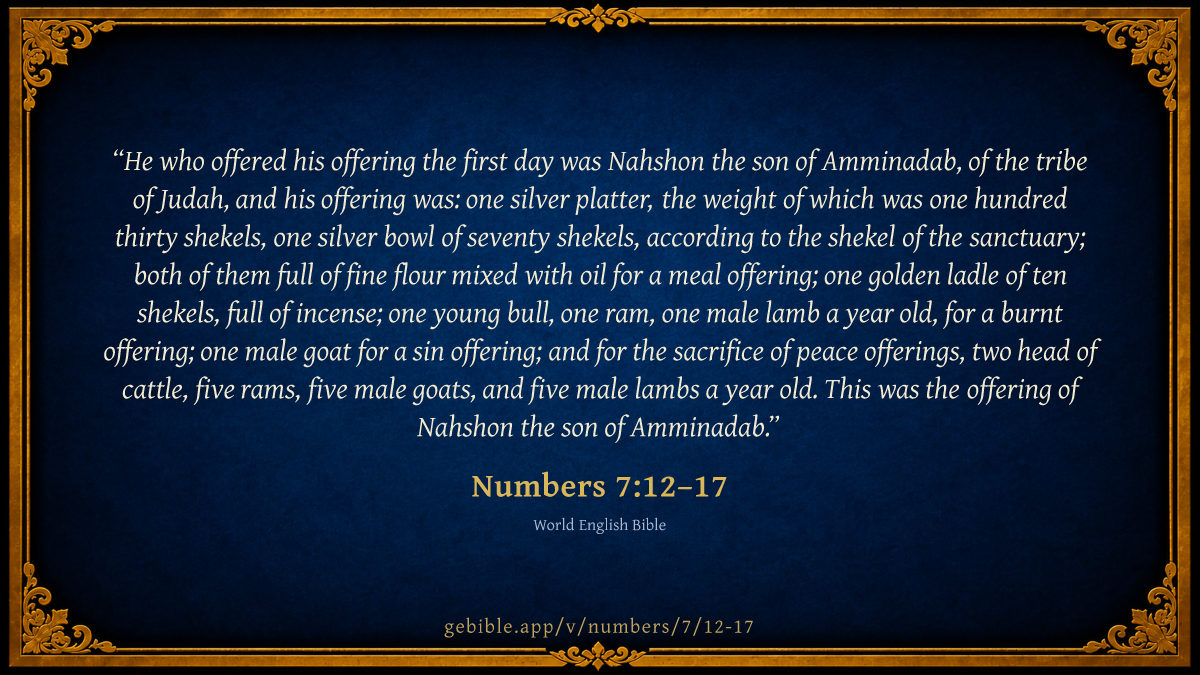
He who offered his offering the first day was Nahshon the son of Amminadab, of the tribe of Judah, and his offering was: one silver platter, the weight of which was one hundred thirty shekels, one silver bowl of seventy shekels, according to the shekel of the sanctuary; both of them full of fine flour mixed with oil for a meal offering;
one golden ladle of ten shekels, full of incense;
one young bull, one ram, one male lamb a year old, for a burnt offering;
one male goat for a sin offering;
and for the sacrifice of peace offerings, two head of cattle, five rams, five male goats, and five male lambs a year old. This was the offering of Nahshon the son of Amminadab.
John Trapp 1656 · Public Domain On vv12, 17 Num 7:12 And he that offered his offering the…
Num 7:12 And he that offered his offering the first day was Nahshon the son of Amminadab, of the tribe of Judah:
Ver. 12. Of the tribe of Judah.] Ut ubique superemineat praerogativa Christi a Iuda oriundi.
John Trapp, A Commentary or Exposition upon All the Books of the Old and New Testament (1647–1656) — public domain. Text from a community e-Sword module.
Matthew Poole 1685 · Public Domain On vv12, 13, 14, 17 In whose name and behalf this offering was made,…
In whose name and behalf this offering was made, and so in the rest.
Matthew Poole's English Annotations on the Holy Bible (1683–1685) — public domain. Text from a community e-Sword/MySword module.
John Gill 1763 · Public Domain On vv12–17 And he that offered his offering on the first…
And he that offered his offering on the first day,.... Was he whose standard was pitched first, at the east, to the rising sun: and this
was Nahshon the son of Amminadab, of the tribe of Judah; who was the prince and captain of that tribe, though the title is not here given him, as to the rest of the princes, this being left to be concluded from his offering first; for if they that offered after him were princes, he must needs be one; or it may be this title is omitted, because the chief prince, of the prince of the tribe of Judah, most peculiarly belongs to a greater Personage, even the Messiah, who was to spring, and did spring from that tribe, Ch1 5:2; and, as Baal Hatturim says, from Nahshon; and who also observes, that Ben Nahshon is the Messiah.
John Gill's Exposition of the Whole Bible (1746–1763) — public domain (CC PDM 1.0). Text via the HelloAO Bible API.
John Wesley 1765 · Public Domain On vv13, 17 Charger - A large dish or platter; to be…
Charger - A large dish or platter; to be employed about the altar of burnt-offering, or in the court; not in the sanctuary, for all its vessels were of gold.
John Wesley, Explanatory Notes Upon the Whole Bible (1754–1765) — public domain. Text via the GEBible commentary corpus.
Adam Clarke 1810 · Public Domain On vv13–14 Verse 13. One silver charger] קערת kaarath, a dish,…
Verse 13. One silver charger] קערת kaarath, a dish, or deep bowl, in which they kneaded the paste. See Ex 25:29.
One silver bowl] מזרק mizrak, a bason, to receive the blood of the sacrifice in. See Clarke on Ex 27:3.
Adam Clarke's Commentary on the Bible (1810–1826) — public domain. Text from a community e-Sword/MySword module.
Joseph Benson 1811 · Public Domain On vv13, 15, 17 Num 7:13-14. One silver charger — This charger, or…
Num 7:13-14. One silver charger — This charger, or broad dish, appears to have been for the use of the altar of burnt-offering in the court of the tabernacle; for all the vessels of the sanctuary were of gold. The use of it seems to have been for receiving the flesh which was offered at the altar, or the fine flour for the meat-offering. Its weight was a hundred and thirty shekels, or about sixty-five ounces. The bowl, again, was for receiving the blood, and it weighed seventy shekels, or about thirty-five ounces. One spoon often shekels of gold — Both the metal and what was in it show this spoon to have been for the use of the golden altar.
Joseph Benson's Commentary on the Old and New Testaments (1811–1818) — public domain. Text from a community e-Sword module.
Albert Barnes 1834 · Public Domain On v12 The several princes make their offerings in the order…
The several princes make their offerings in the order assigned to the tribes Num. 2. It was doubtless the tribes themselves which presented these gifts through their chiefs. The twelve offerings are strictly alike, and were offered on twelve separate days.
Albert Barnes' Notes on the Bible (1834–1885) — public domain. Text from a community e-Sword/MySword module.
Haydock's Catholic Bible Commentary 1859 · Public Domain On vv13–14 Dish, (acetabulum.) Hebrew kaharath. See Exodus xxv. 29. This…
Dish, (acetabulum.) Hebrew kaharath. See Exodus xxv. 29. This present of the prince of Juda weighed five Roman pounds. It was of silver, and consequently could not be used in the sanctuary, but in the court, (Calmet) at the altar of holocausts. (Tirinus)
George Leo Haydock (1774–1849), Haydock's Catholic Family Bible and Commentary, 1859 edition — public domain. Excludes Psalms (Douay-Rheims chapter numbering differs from Protestant) and Deuterocanonical books (Catholic canon only).
Robert Jamieson, A. R. Fausset & David Brown 1871 · Public Domain On v12 He that offered his offering the first day was…
He that offered his offering the first day was Nahshon . . . of the tribe of Judah, &c.--Judah having had the precedence assigned to it, the prince or head of that tribe was the first admitted to offer as its representative; and his offering, as well as that of the others, is thought, from its costliness, to have been furnished not from his own private means, but from the general contributions of each tribe. Some parts of the offering, as the animals for sacrifice, were for the ritual service of the day, the peace offerings being by much the most numerous, as the princes and some of the people joined with the priests afterwards in celebrating the occasion with festive rejoicing. Hence the feast of dedication became afterwards an anniversary festival. Other parts of the offering were intended for permanent use, as utensils necessary in the service of the sanctuary; such as an immense platter and bowl (Exo 25:29). Being of silver, they were to be employed at the altar of burnt offering, or in the court, not in the holy place, all the furniture of which was of solid or plated gold; and there was a golden spoon, the contents of which show its destination to have been the altar of incense. The word rendered "spoon" means a hollow cup, in the shape of a hand, with which the priests on ordinary occasions might lift a quantity from the incense-box to throw on the altar-fire, or into the censers; but on the ceremonial on the day of the annual atonement no instrument was allowed but the high priest's own hands (Lev 16:12).
Jamieson, Fausset & Brown — Commentary Critical and Explanatory on the Whole Bible (1871) — public domain (CC PDM 1.0). Text via the HelloAO Bible API.
Daniel D. Whedon 1874 · Public Domain On vv13–17 13. Charger — Rather, a dish or bowl for…
13. Charger — Rather, a dish or bowl for receiving water or blood. Throughout this chapter, and nowhere else, it is incorrectly translated charger; but in Num_4:7; Exo_25:29; Exo_37:16, it is rendered dish. The Arabic indicates that it was a deep dish. It is not probable that a mixture of flour and oil would have been brought in a platter.
Bowl — Or basin, as in Num_4:14; Exo_27:3; Exo_38:3. Between the various vessels bearing the name of basin, bowl, charger, cup, and dish, it is impossible now to ascertain the precise distinction, as very few, if any, remains of early Jewish metal-ware are known to exist. The tabernacle must have been well supplied with basins or bowls of large capacity for receiving the blood of the sacrifices. Lev_1:5.
Read full note →
Shekel of the sanctuary — See Num_3:47, note.
Meat offering — See Leviticus ii, notes.
Daniel D. Whedon (gen. ed.), Commentary on the Old and New Testaments (1874–1909) — public domain. Text from a community e-Sword module.
The Cambridge Bible for Schools and Colleges 1878 · Public Domain On v13 13. charger] a dish. Cf. Exo_25:29; Exo_37:16.
13. charger] a dish. Cf. Exo_25:29; Exo_37:16.
The Cambridge Bible for Schools and Colleges (gen. ed. J. J. S. Perowne; Cambridge University Press, 1878–1918) — public domain. Text from a community e-Sword module.
The Pulpit Commentary 1880 · Public Domain On vv12–17 Nahshon. The same appointed to act with Moses in…
Nahshon. The same appointed to act with Moses in the census, and to be captain of the children of Judah. (Num_1:7 Num_2:3) The names of the other princes are to be found in the same passages, and their order in presenting is their order for the march. This seems to show that their off, rings were actually made after the arrangement of the camps had been settled.
The Pulpit Commentary (1880–1919), ed. H.D.M. Spence-Jones & Joseph S. Exell — public domain. Text from a community e-Sword module.
unfoldingWord translationNotes 2017 · CC BY-SA 4.0 On vv12, 15 the first day
the first day
"day 1" or "day number 1" (See: Ordinal Numbers)
Read full note →
Nahshon son of Amminadab
These are the names of men. See how you translated these names in Numbers 1:7
weighing 130 shekels
"weighing one hundred and thirty shekels." If necessary, these weights can be written in modern measurements. AT: "weighing nearly one and a half kilograms" or "weighing one kilogram and 430 grams" (See: Numbers and Biblical Weight)
one silver bowl weighing seventy shekels
"one silver bowl weighing 70 shekels." If necessary, these weights can be written in modern measurements. AT: "one silver bowl weighing nearly eight tenths of a kilogram" or "one silver bowl weighting 770 grams" (See: Biblical Weight and Numbers)
by the standard weight of the sanctuary shekel
There were shekels of different weights. This is the one that people had to use in the sanctuary of the sacred tent. If you are converting the weights to modern measures, here is another way to translate this phrase. AT: "measured by the standard weights used in the sanctuary" (See: Biblical Weight)
fine flour mixed with oil
This can be stated in active form. AT: "fine flour that he had mixed with oil" (See: Active or Passive)
one gold dish that weighed ten shekels
If necessary, this can be written in modern measurements. AT: "one gold dish that weighed one tenth of a kilogram" or "one gold dish that weighed 110 grams" (See: Biblical Weight)
translationWords
tribe
Judah
silver
sanctuary
oil
grain offering
gold
incense
unfoldingWord translationNotes — © Distant Shores Media and the Door43 World Missions Community, licensed CC BY-SA 4.0. Source: git.door43.org/Door43/en_tn.
Tyndale Open Study Notes 2022 · CC BY-SA 4.0 On v12 7:12-83 One by one, the tribal leaders brought their…
7:12-83 One by one, the tribal leaders brought their dedicatory gifts and offerings until the entire Hebrew confederation had participated. The repetitious pattern of describing each tribal gift emphasizes the communal nature of this ceremony; all tribes played a role in consecrating their place of worship. The detailed listing might reflect the meticulous record keeping of an archive or ledger. As noted in the record for each tribe, the silver vessels contained grain offerings, and the gold vessels held incense. Every tribe also brought animals as a burnt offering, a sin offering, and a peace offering, as specified in Leviticus.
Tyndale Open Study Notes — © Tyndale Open Resources, licensed CC BY-SA 4.0. Text via the HelloAO Bible API.